


Markets were volatile in the third quarter as investors faced political turmoil and increased uncertainty about future economic growth, but the return of Fed rate cuts and solid corporate earnings helped to offset those political and economic anxieties. The S&P 500 hit another new all-time high and finished the quarter with strong gains.
Markets started the third quarter with a continuation of the first-half rally thanks to good Q2 earnings results and generally solid economic data. However, while the S&P 500 hit a new all-time high in mid-July, the second half of the month proved more volatile. That volatility was driven by an intense rotation within the S&P 500 from the heavily weighted tech sector (more than 30% of the S&P 500) to other, smaller market sectors such as utilities, financials, and industrials. The impetus for this dramatic rotation was a combination of profit-taking following the substantial AI-driven tech stock rally and a larger-than-expected decline in inflation, which caused Treasury bond yields to fall sharply as investors anticipated imminent rate cuts by the Fed. That expectation boosted the economic outlook and caused investors to rotate towards market sectors that benefit more directly from a strong economy. So, while investors didn’t exit the market entirely, the decline in the tech sector weighed on the S&P 500 and was not fully offset by gains in other, smaller market sectors. The S&P 500 finished July well off the mid-month highs and with just a small gain, up 1.1%.
The late-July volatility continued in early August as a much-weaker-than-expected July jobs report, released on August 2nd, added to economic concerns. The unemployment rate rose to the highest level since November 2021, and investors’ fear of an economic hard landing triggered a sharp, intense decline that saw the S&P 500 fall 3% on Monday, August 5th, the worst one-day selloff in nearly two years. However, that decline proved brief as economic data over the next few weeks was generally solid, which helped calm investors’ anxieties. Then, on August 23rd, at the Kansas City Fed’s Jackson Hole Economic Symposium, Fed Chair Powell told markets the “time had come” for the Fed to cut rates. That all but guaranteed a rate cut at the September meeting. That message further fueled the rebound in stocks, and the S&P 500 finished August with a 2.3% gain, completing an impressive rebound from early-month weakness.
The rally continued in September thanks to growing expectations for a large Fed rate cut that offset lackluster economic data. The August jobs report, released in early September, was another disappointment and again increased concerns about an economic slowdown, and stocks were modestly volatile to start the month. However, following that report, numerous financial journalists and ex-Fed officials made public calls for the Fed to cut interest rates by 50 basis points at the September meeting, and expectations for a larger-than-expected rate cut helped offset underwhelming economic data and the S&P 500 hit a new all-time high ahead of the Fed decision. Then, on September 18th, the Fed met market expectations, cut rates for the first time in four years, and promised additional rate cuts between now and year-end. Investors welcomed this news, and the S&P 500 surged to a new high and finished the month and quarter with more solid gains, adding to the strong year-to-date return.
Finally, politics and the looming presidential election impacted markets during the third quarter. Investors started the quarter expecting a Trump victory and Republican control of Congress, based on polling following President Biden’s struggles at the June debate and after the failed assassination attempt on the former president. However, those expectations changed rapidly following Biden’s withdrawal from the race and the nomination of Vice President Kamala Harris. As the third quarter ended, national polls slightly favored Harris while the outlook for the control of Congress remained uncertain.
Third Quarter Performance Review
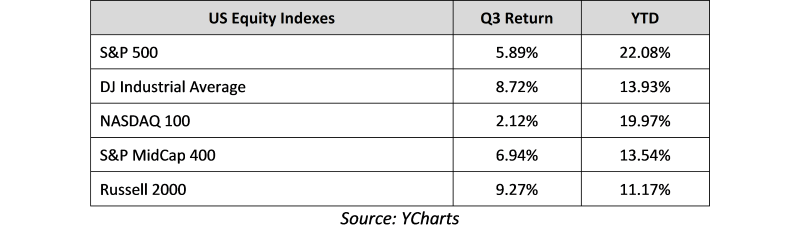
Investor expectations for falling interest rates and bond yields were the major influences on index, sector, and factor performance during the third quarter, as markets were broadly positive but with some notable changes in leadership.
Starting with market capitalization, small caps outperformed large caps for the first time in 2024 as investors rotated out of large-cap stocks and into more economically sensitive small caps, as they historically have received the most benefit from lower borrowing costs that come with falling interest rates.
From an investment style standpoint, value handily outperformed growth, although both investment styles posted positive returns for the third quarter. The outperformance of value was evidence of the significant rotation we saw from the tech sector (which dominates most growth funds) to lower P/E and more economically sensitive parts of the market, such as financials, industrials, utilities, and others.
On a sector level, nine of the 11 S&P 500 sectors finished the third quarter with a positive return, continuing the broad year-to-date rally we’ve all enjoyed. Evidence of the influence of lower yields on returns can be seen in the sector outperformers, as utilities and real estate, two sectors that have relatively large dividends and benefit when bond yields are falling, handily outperformed the remaining nine S&P 500 sectors.
Looking at sector laggards, the tech and energy sectors were the only sectors to finish the third quarter with negative returns, as investors rotated out of tech and towards those higher dividend and more cyclically sensitive sectors. Energy, meanwhile, was the worst performing sector in the quarter as concerns about global growth (especially in China) weighed on oil demand expectations.
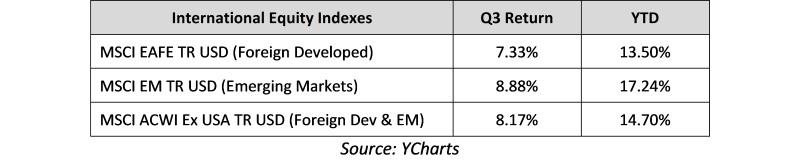
Internationally, foreign markets outperformed the S&P 500 in the third quarter as the relative underperformance of the tech sector was a headwind on S&P 500 returns. Foreign developed markets saw a solid rally in the third quarter as investors anticipated additional rate cuts from the European Central Bank and other major global central banks. Emerging markets also outperformed the S&P 500 and foreign developed markets as the Chinese government announced numerous stimulus measures late in September, and that boosted Chinese stocks and emerging market indices and ETFs.
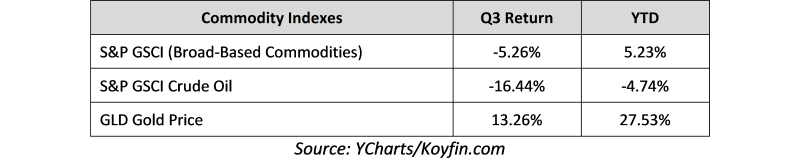
Commodities were mixed but, in aggregate, saw moderate losses in the third quarter thanks mostly to weakness in oil prices. Oil declined sharply in Q3 as global demand expectations were reduced courtesy of soft Chinese economic data early in the quarter and generalized global growth concerns. Gold, however, staged a strong rally thanks to elevated geopolitical uncertainty and the weaker dollar, as gold hit a new all-time high in Q3.
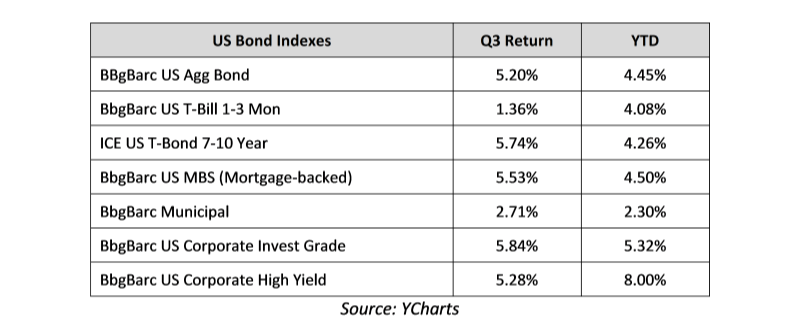
Switching to fixed-income markets, the leading benchmark for bonds (Bloomberg Barclays US Aggregate Bond Index) saw a very strong quarterly return thanks to falling inflation, mixed U.S. economic data, and investors' anticipation of an aggressive rate-cutting cycle from the Fed.
Looking deeper into the bond markets, longer-duration bonds handily outperformed those with shorter durations as investors reached for longer-term yield amidst falling inflation and underwhelming labor market data. Shorter-duration bonds also saw a positive return, however, as investors anticipated the start of the Fed's aggressive rate-cutting cycle.
Turning to the corporate bond market, investment-grade bonds outperformed lower-quality “junk” bonds, although both saw strong quarterly gains. For the first time in 2024, investors favored investment-grade bonds amidst increased economic uncertainty, as they sought the safety of higher-rated bonds over increased yield.
Fourth Quarter Market Outlook
With the start of the Fed’s rate-cutting cycle behind us and the general pace of future cuts now broadly known, the focus for the final quarter of 2024 will turn towards economic growth and politics. Given the volatile nature of both, it’s reasonable to expect periods of elevated volatility over the coming months (but, as we saw in the third quarter, markets can still move higher even amidst increased volatility).
Starting with economic growth, expectations for aggressive Fed rate cuts helped investors look past some soft economic reports in Q3, especially in the labor market. However, with those rate cuts now behind us, we should expect markets to be more sensitive to any disappointing economic data, especially in the labor market. The bottom line is that with the S&P 500 just off record highs, the market has priced in a soft economic landing. If the economic data in Q4 is weaker than expected and recession fears grow, market volatility will increase between now and year-end.
Politics, meanwhile, will become a more direct market influence as we approach the November 5th election. Depending on the expected and actual outcome, we could see an increase in macro and microeconomic volatility that could impact the broader markets and specific industries and sectors (e.g., oil and gas, renewables, financials, and others). That volatility will stem from the uncertainty surrounding potential future policy changes (or lack thereof) regarding important financial and economic issues such as taxes, global trade, and the long-term fiscal health of the United States.
Finally, geopolitical risks remain elevated, and while the war between Russia and Ukraine and the ongoing conflict between Israel, Hamas, and now Hezbollah hasn’t negatively impacted global markets this year, that’s always a possibility. These situations must be consistently monitored as the spread of these conflicts would impact markets, regardless of any Fed rate cuts or election outcomes.
In sum, as we start the fourth quarter, the market does face economic, political, and geopolitical uncertainties. However, market performance has been very strong in 2024; momentum remains positive, and this market has proven resilient throughout the year. Additionally, current economic data is still pointing to a soft economic landing. Finally, while political headlines may cause short-term investor anxiety and volatility, market history is extremely clear: Over time, the S&P 500 has consistently advanced regardless of which party controls the government, and the average annual performance of the S&P 500 is solidly positive in both Republican and Democratic administrations.
So, while there is elevated uncertainty between now and year-end, and it’s reasonable to expect an increase in short-term volatility, the fundamental underpinnings of this market remain broadly positive.
At Fezza Wealth Management LLC, I understand the risks facing the markets and the economy, and I am committed to helping you effectively navigate this investment environment. Successful investing is a marathon, not a sprint, and even bouts of intense volatility are unlikely to alter a diversified approach set up with a goal to meet your long-term investment goals.
Therefore, it’s critical for you to stay invested, remain patient, and stick to the plan, as I've worked with you to establish a unique personal allocation target based on your financial position, risk tolerance, and investment timeline.
I thank you for your ongoing confidence and trust. Please rest assured that I will remain dedicated to helping you work towards your financial goals.
Please do not hesitate to contact me with any questions or comments or to schedule a portfolio review.
Securities and advisory services offered through LPL Financial, a Registered Investment Advisor, Member FINRA/SIPC
The Standard & Poor’s 500 Index is a capitalization weighted index of 500 stocks designed to measure performance of the broad domestic economy through changes in the aggregate market value of 500 stocks representing all major industries.
The Dow Jones Industrial Average is comprised of 30 stocks that are major factors in their industries and widely held by individuals and institutional investors.
The NASDAQ Composite Index measures all NASDAQ domestic and non-U.S. based common stocks listed on The NASDAQ Stock Market. The market value, the last sale price multiplied by total shares outstanding, is calculated throughout the trading day, and is related to the total value of the Index.
The S&P Midcap 400 Stock Index is an unmanaged index generally representative of the market for the stocks of mid-sized US companies.
The Russell 2000 Index is an unmanaged index generally representative of the 2,000 smallest companies in the Russell 3000 index, which represents approximately 10% of the total market capitalization of the Russell 3000 Index.
The MSCI EAFE Index is a free float-adjusted market capitalization index that is designed to measure the equity market performance of developed markets, excluding the US & Canada. The MSCI EAFE Index consists of the following developed country indices: Australia, Austria, Belgium, Denmark, Finland, France, Germany, Hong Kong, Ireland, Israel, Italy, Japan, the Netherlands, New Zealand, Norway, Portugal, Singapore, Spain, Sweden, Switzerland and the UK.
The Bloomberg Barclays U.S. Aggregate Bond Index is an index of the U.S. investment-grade fixed-rate bond market, including both government and corporate bonds.
The Bloomberg Barclays U.S. 1-3 Year Government/Credit Index is an unmanaged market value weighted index composed of all bonds of investment grade with a maturity between one and three years.
The Bloomberg Barclays U.S. Mortgage Backed Securities Index is an unmanaged market value weighted performance benchmark that tracks mortgage-backed securities issued by Ginnie Mae, Freddie Mac, and Fannie Mae with 15-year and 30-year maturities. It is a subset of the Barclays Aggregate Bond Index.
The Bloomberg Barclays U.S Corporate High-Yield Bond Index is an unmanaged market value weighted index composed of fixed-rate, publicly issued, non-investment grade debt.
Stock investing includes risks, including fluctuating prices and loss of principal.
The prices of small cap stocks are generally more volatile than large cap stocks.
Content in this material is for general information only and not intended to provide specific advice or recommendations for any individual. All performance referenced is historical and is no guarantee of future results. All indices are unmanaged and may not be invested into directly.
The economic forecasts set forth in this material may not develop as predicted and there can be no guarantee that strategies promoted will be successful.
There is no guarantee that a diversified portfolio will enhance overall returns or outperform a non-diversified portfolio. Diversification and asset allocation do not protect against market risk.
International investing involves special risks such as currency fluctuation and political instability and may not be suitable for all investors. These risks are often heightened for investments in emerging markets.
Bonds are subject to market and interest rate risk if sold prior to maturity. Bond values will decline as interest rates rise. Bonds are subject to availability, change in price, call features and credit risk.
Bond yields are subject to change. Certain call or special redemption features may exist which could impact yield.
The market value of corporate bonds will fluctuate, and if the bond is sold prior to maturity, the investor’s yield may differ from the advertised yield.
The fast price swings in commodities will result in significant volatility in an investor’s holdings. Commodities include increased risks, such as political, economic, and currency instability, and may not be suitable for all investors.
Government bonds and Treasury bills are guaranteed by the US government as to the timely payment of principal and interest and, if held to maturity, offer a fixed rate of return and fixed principal value.